The following contains discussion of content that was not originally made by me. Please help the original content rank higher in the algorithms by viewing it at its original location, and also giving it a like and a comment and so on (if applicable):
Also, be sure to follow/subscribe to/support the original content creator on all their platforms:
- Website: Ichthys.com
The things labeled "summary points" on this page are highly derivative of the original content, since they are summarizing the original content.
Video
Summary
Israel holds a special place in God’s plan. Jewish believers are the foundation for the holy building that God is erecting - not only in the Jewish age, but also in the Church age. Jewish believers have played and continue to play a critical part in all generations of the Church. Salvation belongs to the Jews as first priority, coming to the Gentiles by the grace of God. Rather than replacing Israel, gentile believers have become part of God’s household along with Israel. Gentile believers are the wild olive branch that has been grafted into the natural olive tree Israel.
Israel has largely rejected their Messiah, tripping over the Cornerstone, Jesus Christ, and the “offense” of His cross. Jesus Himself mourned the hardness of the Jews. While many first century Jews rejected the gospel just as their Judean countrymen had rejected their own Messiah, Jewish believers were both the original foundation of the Church and continued to play a huge role after the influx of the gentiles had begun. Despite this general “hardness” towards Christ that currently dominates the Jewish people, Israel will once more take the lead in spectacular fashion when the Jewish age overlaps with the Church age for its final seven years, known as the Tribulation. This leading role is seen in two major ways: the ministries of Moses and Elijah, and also of the 144,000 witnesses. At Christ’s Second Advent, the hardness will end as the vision of Him returning in glory will bring about a profound and glorious change of heart of Israel and many Jewish people will turn to Christ for salvation. In the millennium, Jesus will rule from Jerusalem, as the inheritor of the Davidic line of Jewish Kingship. All this makes our Jewish brethren the perfect people to run alongside as we worship our Savior, who delivered Jew and Gentile alike.
Content
Audio clip from Ichthys
It should not be overlooked that in the preceding passage, gentile believers of the present day are portrayed as having become part of the household of God along with Israel, rather than replacing Israel. This picture is consistent with every other passage in the New Testament where the issue is discussed. The gentiles are the wild olive branch that has been grafted into the natural olive tree Israel (Rom.11:13-24). The truth of the matter is that the Church is composed of Jews and gentiles, and that Jewish believers are the foundation for the holy building that God is erecting – not only in the Jewish age, but in the Church age as well:
- All of the apostles of Christ were Jewish. And although the New Testament is written almost exclusively in Greek, the dominant gentile language of the time, all of the writers of the Bible, New Testament as well as Old Testament, were Jewish (cf. Deut.4:6-8; Ps.147:19-20; Is.59:21; Rom.3:1-2).
- Though many first century Jews rejected the gospel in the same way that their Judean countrymen had rejected their own Messiah, even a cursory reading of Acts and the Epistles demonstrates clearly that Jewish believers were both the original foundation of the Church and continued to play a huge role after the influx of the gentiles had begun.
- Jewish believers not only exist but have played and continue to play a critical part in all generations of the Church (Rom.11:5). For the gospel is theirs by first priority, and ours (as gentiles) by the grace of God: “to the Jew first, and also to the Greek (i.e., gentile)” (Rom.1:16; cf. Matt.10:5; 15:26; Acts 13:46; Rom. 2:9-10).
- The hardness of the majority of the line of Israel during the Church age has been since Paul’s day a heavy burden on the heart of their believing countrymen (Rom.9:3; 10:1). Jesus Himself mourned their lack of belief (Matt.23:37), and predicted these “times of the gentiles” which comprise the two millennial Church age days, when gentiles would flood into the Kingdom while Jewish belief would be reduced to a trickle (Lk.21:24; cf. the wedding banquet parable where those invited fail to come and others are brought in instead: Matt.22:1-14; Lk.14:15-24). In the case of the resistant majority, two issues always seem to lie at the core of this resistance which is in such stark contrast to the preeminence of Israel in matters of faith both in the past and in the prophesied future:
a) refusal to accept a suffering Messiah (Matt.16:21-23; Jn.6:66; 1Cor.1:22-23; cf. the desire for displays of miraculous power instead of the cross: Matt.16:4; Mk.8:11-12; Lk.11:29), and consequently tripping over the Cornerstone, Jesus Christ, and the “offense” of His cross (Rom.9:32-33; 1Cor.1:22-23; Gal.5:11; Heb.11:26; 12:2; 13:13).
b) resentment over the inclusion of gentiles into the family of God, seed of Abraham by faith alone (Matt.27:18; Acts 13:43-45; 17:5; 22:21-22; Rom.10:2; cf. Lk.15:25-32), and, corollary to this, trusting in their own righteousness from the Law instead of faith (Rom.9:30-32; 10:3-4). This second issue is very much a post-cross problem. Jesus’ earthly ministry was focused entirely upon Israel, not the gentiles, so that our Lord’s contemporaries never had this excuse. They rejected Him before believing gentiles became an issue (Matt.7:6; 10:15).
This “hardness in part” of Israel is destined to continue “until the fullness of the gentiles comes in . . .” (Rom.11:25), that is, until the calling out of the mass of gentile believers is complete, a process characterizing the Church age, and a process that will continue and be completed just prior to the 2nd Advent of Christ (cf. Rev.11:2; 12:17). At the moment of His return, everything will change for Israel, and the vision of Him returning in glory will bring about a profound and glorious change of heart (Zech.12:10-14; Rev.1:7; cf. Joel 2:30-32; Matt.24:30).
- Despite this general “hardness”, during the last phase of the Church age, when the Jewish age overlaps with it for its final seven years known as the Tribulation, Israel will once more take the lead in spectacular fashion. Moses and Elijah, the two witnesses of Revelation chapter eleven, will be resuscitated for a warning ministry of the greatest significance. These are the only two Jewish age believers of whom we know whose bodies were “taken” by God for precisely this purpose (Deut.34:6 compared with Jude 1:9; 2Ki.2:11-12). And the final world-wide witness of the Gospel (and God’s warning of impending doom) will be carried to the four corners of the earth by 144,000 Jews (Rev.7:1-8; 14:1-5), thus partially fulfilling through Jewish hands the prophecy of universal evangelization (albeit as an indirect witness in the case of the gentiles: Matt.24:14; Mk.13:10 compared to Revelation 14:6-7, the ultimate fulfillment of the prophecy).
- The Millennial glories of Israel and her undisputed prominence when the Son of David returns to rule the earth as her King show clearly the pride of place that Abraham’s seed enjoys in the plan and family of God (see section IV.2 below and also Part 1 of this series for Millennial details).
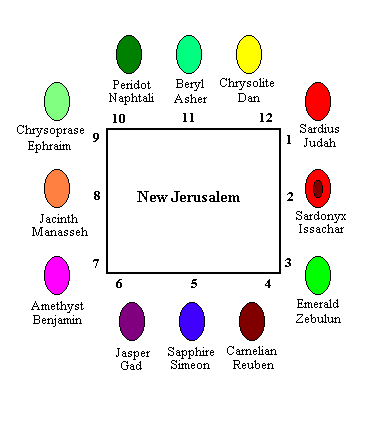
- The preeminence of Israel can also be clearly seen from the description of the eternal state in Revelation chapters 21-22. The twelve gates of New Jerusalem (named for the historical Jewish capital: for more, see the link: The New Jerusalem) are named for Israel’s twelve tribes (21:12), and the twelve foundations of its wall are named for the twelve (Jewish) apostles (21:14).
- And the Messiah comes from Israel (Jn.4:22; cf. Ps.2:8). We should never forget that Christ is Jewish, the seed of Abraham, the Vine of the vine of Israel (Ps.80:8-16; Jn.15:1ff), the Branch of David’s line (Is.4:2; Jer.23:5; 33:15; Zech.3:8; 6:12), and, prophetically, the Light of Israel, the Light of the world (Is.42:6; 49:6-7; 55:3-5 compared with Jn.1:5; 3:19; 8:12; 9:5; 12:46).
Therefore while it is true that gentiles are Jesus’ “other sheep” (Jn.10:16; 11:52; cf. Zech.2:11), that they have been made one with Jews in Christ (Gal.3:28; cf. our “brotherhood” in Matt.23:8), that the barrier between the two groups has been broken down through His cross (Eph.2:11-21), and that there will be many from the east and the west who will recline together with the Lamb at His victory banquet (Is.25:6; Matt.8:11; cf. Zech.2:11), Christians of gentile stock need to understand that we are Israel’s spiritual seed (Rev.12:17), and sons of Abraham by faith (Rom.4:11 & 16). For we are a wild olive branch, and it is the root of Israel which bears us, not the other way around:
So even if some of the branches have been broken off, and you, wild olive branch that you are, have been grafted into their place and have become a partaker of the rich root of the natural olive tree, don’t boast over those branches. For if you boast, [remember] that you don’t support the root, but the root supports you. Now someone may say “Branches have been broken off for me to be grafted in.” True enough. They were broken off because of their unbelief, and you stand secure because of your faith. But don’t think arrogant thoughts. Rather, have a care. For if God didn’t spare the natural branches, He will not spare you either. So consider God’s mercy and severity. For He is severe towards those who have fallen away, but merciful towards you – if, that is, you continue in that mercy. But if you don’t, you too will be cut off. And if they don’t continue in their unbelief, they will be grafted back in.
Summary points
Gentiles have joined Israel in the household of God, rather than replacing Israel. We are a wild olive branch that has been grafted onto the natural olive tree of Israel (Romans 11:13-24). It is the root of Israel which bears us, not the other way around, and we must never forget that.
So while it is true that Gentiles are now fully part of the body:
- We are Jesus’s “other sheep” (Jn.10:16; 11:52; cf. Zech.2:11)
- We have been made one with the Jews in Christ (Gal.3:28; cf. our “brotherhood” in Matt.23:8)
- We no longer have a barrier between us and the Jews, since it was broken down through the cross (Ephesians 2:11-21)
- We will feast with the Lamb at his victory banquet, having come from the east and the west (Is.25:6; Matt.8:11; cf. Zech.2:11)
We also need to remember that we are nonetheless fundamentally Israel’s spiritual seed (Revelation 12:17), and sons of Abraham by faith (Rom.4:11, 16). Expressing distaste for Israel is therefore expressing distaste for our own spiritual constitution, which is… eminently irrational.
Jewish believers are the foundation for the holy building that God is erecting – not only in the Jewish age, but in the Church age as well. We can see this in eight clear ways:
1) All of the apostles of Christ were Jewish
Although the New Testament is written almost exclusively in Greek, the dominant gentile language of the time, all of the writers of the Bible, New Testament as well as Old Testament, were Jewish (cf. Deut.4:6-8; Ps.147:19-20; Is.59:21; Rom.3:1-2).
The oracles of God were entrusted entirely to the Jews.
2) Jewish believers were the original foundation of the Church, and continued to play a huge role after the influx of the Gentiles had begun
Though many first century Jews rejected the gospel in the same way that their Judean countrymen had rejected their own Messiah, even a cursory reading of Acts and the Epistles demonstrates clearly that the Early Church was founded initially by the Jews, and spread primarily through the actions of Jewish evangelists (particularly in the earliest days).
3) Jewish believers not only exist, but have played and continue to play a critical part in all generations of the Church
Compare Romans 11:5—the concept of God’s remnant most certainly can be applied to His special people.
The gospel is theirs by first priority, and ours (as Gentiles) by the grace of God: “to the Jew first, and also to the Greek (i.e., gentile)” (Rom.1:16; cf. Matt.10:5; 15:26; Acts 13:46; Rom. 2:9-10).
4) The hardness of the majority of the line of Israel during the Church age has, since Paul’s day, been a heavy burden on the heart of their believing countrymen
We see this clearly in the writings of Paul in Romans 9:3 and Romans 10:1, among other places. Jesus Himself also mourned the Jews’s lack of belief (Matt.23:37).
Despite mourning it, Jesus did predict this present hardness. We can see this in, for example, Luk 21:24, and the parable of the wedding banquet where those invited fail to come and others are brought in instead: Matt.22:1-14; Lk.14:15-24.
So what causes this hardness of the majority? Two big things:
- Refusal to accept a suffering Messiah (Matt.16:21-23; Jn.6:66; 1Cor.1:22-23; cf. the desire for displays of miraculous power instead of the cross: Matt.16:4; Mk.8:11-12; Lk.11:29), and consequently tripping over the Cornerstone, Jesus Christ, and the “offense” of His cross (Rom.9:32-33; 1Cor.1:22-23; Gal.5:11; Heb.11:26; 12:2; 13:13).
- Resentment over the inclusion of gentiles into the family of God, seed of Abraham by faith alone (Matt.27:18; Acts 13:43-45; 17:5; 22:21-22; Rom.10:2; cf. Lk.15:25-32), and, corollary to this, trusting in their own righteousness from the Law instead of faith (Rom.9:30-32; 10:3-4). This second issue is very much a post-cross problem. Jesus’ earthly ministry was focused entirely upon Israel, not the gentiles, so that our Lord’s contemporaries never had this excuse. They rejected Him before believing gentiles became an issue (Matt.7:6; 10:15).
When will the hardness of the majority end?
It is destined to continue “until the fullness of the gentiles comes in…” (Rom.11:25), that is, until the calling out of the mass of gentile believers is complete, a process characterizing the Church age, and a process that will continue and be completed just prior to the 2nd Advent of Christ (cf. Rev.11:2; 12:17).
At the moment of His return, everything will change for Israel, and the vision of Him returning in glory will bring about a profound and glorious change of heart (Zech.12:10-14; Rev.1:7; cf. Joel 2:30-32; Matt.24:30).
5) Despite the present hardness, during the last phase of the Church age, Israel will once more take the lead in spectacular fashion
We see this in two large ways:
- Moses and Elijah, the two witnesses of Revelation chapter eleven, will be resuscitated for a warning ministry of the greatest significance. These men are two of the Jewish people’s most important prophets.
- The final world-wide witness of the Gospel (and God’s warning of impending doom) will be carried to the four corners of the earth by 144,000 Jews (Rev.7:1-8; 14:1-5), thus partially fulfilling through Jewish hands the prophecy of universal evangelization (albeit as an indirect witness in the case of the Gentiles: Matt.24:14; Mk.13:10 compared to Revelation 14:6-7, the ultimate fulfillment of the prophecy).
6) During the Millennium, Israel’s pride of place in the family of God will be clearly apparent
The Son of David will return to rule the earth as her King… her Jewish King.
This is to say, while Jesus will in fact rule the entire world, he will do so from Jerusalem, and will do so as the inheritor of the Davidic line of Jewish Kingship. From this, it will be obvious to all that Israel has special significance in God’s family.
7) The New Jerusalem—the eternal city of God—through its very construction points towards the importance of Israel
The twelve gates of New Jerusalem (named for the historical Jewish capital: for more, see the link: The New Jerusalem) are named for Israel’s twelve tribes (Revelation 21:12).
The twelve foundations of the wall of the New Jerusalem are named for the twelve (Jewish) apostles (Revelation 21:14).
8) The Messiah comes from Israel
Salvation comes from the Jews; the King of the Universe is Jewish! (See Jn.4:22, and cf. Ps.2:8).
We should never forget that Christ is Jewish, the seed of Abraham, the Vine of the vine of Israel (Ps.80:8-16; Jn.15:1ff), the Branch of David’s line (Is.4:2; Jer.23:5; 33:15; Zech.3:8; 6:12), and, prophetically, the Light of Israel, the Light of the world (Is.42:6; 49:6-7; 55:3-5 compared with Jn.1:5; 3:19; 8:12; 9:5; 12:46).
Follow-on topics
I think this is an excellent place to examine how wholly illogical antisemitism is. Jesus was Jewish. All twelve Apostles were Jewish. How then can we think there is something wrong with being Jewish?
Moreover, the notion that Christians are somehow separate from the Jews is complete nonsense to begin with. Like that passage in Romans 11 (Romans 11:13-24) makes so very clear, we have been grafted onto Israel. How then can we think to attack the Jews? Is that not attacking ourselves?
Clearly, God does not view believing and unbelieving Israel in the same way. But that does not give us leave to abuse unbelieving Israel, for soon enough “their kind” will in fact turn to Christ, in a massive wave of belief that fulfills all sorts of Old Testament prophecy. In other words, the Jew mocked today will tomorrow be our brother or sister in the body of Christ. For a time they may have hardened their hearts towards God’s truth, but God will regather them fully when the time comes, and woe to those who thought to persecute them when that time does come! They will find themselves treated in the same way as Antichrist, who the Bible says will likewise oppress God’s chosen people. Look at his end, and you will know the end of those who persecute the Jews.
Jewish people are the people of prophecy and promise. Messing with them is messing with God. If nations are like children playing upon a playground, then picking on Israel is like shoving down the child who has a big brother who will completely end you; you won’t just have a bad day, there will be nothing left of you. You can’t handle this big brother. The Babylonians couldn’t. The Assyrians couldn’t. Death couldn’t. What makes you think you can, hm?
God is jealous and possessive (in every way that is positive) when it comes to His people. He doesn’t tolerate other people getting in the way, or leading his sheep astray. Human shepherds may whack those who harm their sheep with a staff. That probably hurts. Now imagine what it means to have an Omnipotent being who has the power to “destroy both soul and body in hell” (Matthew 10:28) do the same.
All of this is why antisemitism is a bad move. Even if someone did not have an ounce of human decency, if they were rational, they still wouldn’t touch the Jews for these reasons we’ve been discussing. The consequences are so terrible that out of sheer self-interest, nobody in their right mind would provoke God in this way.
Yet the truly shocking thing is that so many people do in fact provoke God in this way. Throughout history, the Jews have faced terrible persecution, and it continues into the present. In fact, I would argue that antisemitism is clearly on the rise.
The reasons for this are complex and multifaceted, but no matter what, we have nothing to be resentful about in God’s treatment of the Jews. We should not be like one child jealous of the attention their sibling receives from their Father. Why? Because God does not show favoritism (Romans 2:11). Like the passage from Romans 11 that we keep bringing up mentions, God did not spare the natural-born branches on the tree if they chose not to believe. The Jews were given much, and were shown God’s favor. But they also carried a terrible responsibility in this, for to whom much is given, much is expected (Luke 12:48).
And this is why we should only want the best for the Jews. They compete with us for nothing; God’s love is not zero sum like that. Our Jewish brothers and sisters (those who believe) ought to be our very best friends in God’s truth. They can understand God’s mercy and deliverance; it is literally in their DNA. Centuries and millennia of heritage point them towards honoring a God who delivered their forefathers from Pharaoh by the might of His hand, towards a God who drove out powerful nations before them, and gave them an inheritance forever. Because of their background, God’s promises to Abraham and the other Patriarchs are “family matters” to them. It makes it hit different for them, in a good way.
Can you not see that all this makes our Jewish brethren the perfect people to run alongside as we worship our Savior, who delivered Jew and Gentile alike?